Wester-Amstel

Categories
News

Jac Lissone: the start of 125 years of Lissone-Movig’s at Wester-Amstel

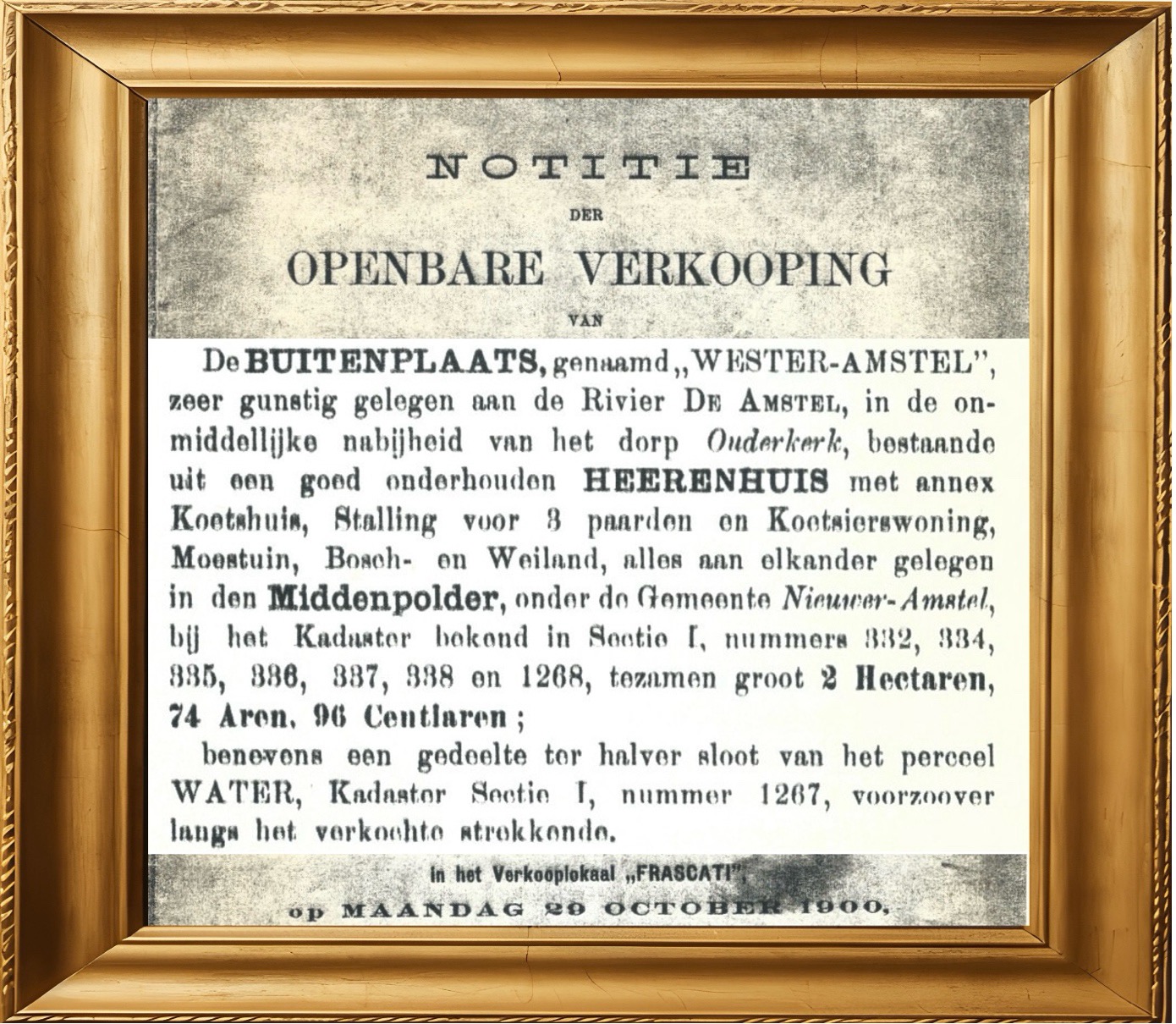
On Monday, 29 October 1900, Jac Lissone purchased the country estate Wester-Amstel at an auction in Frascati, Amsterdam. The country estate was described as a “well-maintained MANOR HOUSE, with a coach house, stables for three horses, and a coachman’s residence; a kitchen garden; and woods and meadows, covering a total area of 2 hectares, 74 ares, and 96 centiares.” His winning bid was 12,000 guilders. With this, the Lissone family made their entrance onto the nearly two-and-a-half-century-old estate. Now, 125 years later, his descendants still manage it.

Who was this man, whose full name was Jacobus Philippus Johannes Franciscus? Where did he get his money from? What motivated him to make this purchase? And what role did his wife, Catharina, play behind the scenes?

Independent from a young age
Jacobus Lissone was born in Rotterdam on 24 February 1840, the eldest of four children. His father and grandfather were from Amsterdam. His great-grandfather had come to Amsterdam from Bellinzona in the Swiss-Italian region and was registered as a citizen (‘poorter’) in 1768, with his profession listed as merchant. He likely traded in tropical fruits – such as oranges, candied dates, etc. – for which his Italian contacts came in handy.

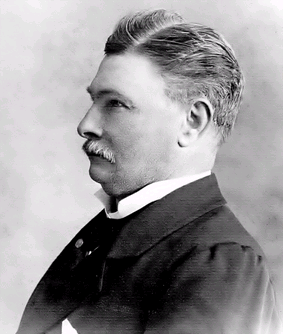
Jacobus Philippus Johannes Franciscus Lissone. Nickname: Jac. (Photo: archive of the J.Ph.J.F. Lissone Foundation)
“Born in Rotterdam” Source: wiewaswie.nl

Jac's mother, Cornelia Houtman, died when he was seven years old. Two years earlier, his younger brother had passed away, followed by his sister when he was ten. His only remaining brother would pass away at the age of 25. These events undoubtedly shaped him.

He once told his son Jacques that from the age of twelve he had to provide for himself. He likely apprenticed with his grandfather in the exotic fruit trade. Advertisements show that, at the ages of 20 and 21, he repeatedly acted as a “huissier” (a kind of court officer/bailiff) at auctions of bankrupt estates. These estates always involved exotic fruit, such as candied ginger, a highly sought-after delicacy at the time.

“Court officer”, Nieuwe Rotterdamse Courant, 20/7/1861

Entrepreneur and marketing talent
When Jac was 22, he was registered at an address on Stadhouderskade together with his father and his brother, who was still alive at the time. His father remarried. Meanwhile, Jac, a Catholic, had met his future wife, Catharina Schleger, a Lutheran. They married on 13 July 1864 in Rotterdam and went to live in the port city. Jac had returned to his hometown. There he started his own business, selling exotic fruits and delicacies.


The young entrepreneur recognised the great advantages of brand recognition and advertising. Numerous advertisements can be found in newspapers from that period:

“Anyone fancy a Macedoine?”, De Maasbode, 23 October 1873. Source: Delpher.nl

He was creative and customer-oriented. At J.P. Lissone, even 150 years ago, you could already return a parcel if the contents were not ‘found satisfactory’. Revolutionary at the time, commonplace today.

“Money back!”, De Maasbode, 19 October 1873. Source: Delpher.nl

The Lissone couple prospered. They had five children in Rotterdam.


The enterprising Jac expanded his delicatessen business with a courier service to London. He travelled there frequently. On the much larger London market, he purchased exclusive foods that only the very wealthy could afford. That same social elite also required a reliable service to transport valuable goods and financial documents to London. This courier service proved to be a gap in the market. He earned a good income from it, at least until competition arrived from the Rijkspostpakkettendienst (now PostNL).

“Born in the City of Amsterdam”, Algemeen Handelsblad, 21/9/1876

In 1874, the family moved to Amsterdam. In 1876, Jacobus established a branch of his delicatessen business in the Pijpenmarkt, now part of Nieuwezijds Voorburgwal. He did not let details about his birthplace hinder his creativity. Amidst all of their business ventures, the couple had three more children. Ultimately, five of the eight would reach adulthood. The travel agency, delivery service, and family were all housed on the Singel.


The first group trip
Jac knew London like the back of his hand. It was therefore no surprise that in 1876 he allowed himself to be persuaded by a friend, Dr Haksteen, to accompany him and a small group on a trip to London. On 24 May, the twelve travellers set off for England with their guide. The trip was a great success. Jac proved to be an excellent organiser and a very entertaining tour guide. The ever-savvy advertiser Jac even had the twelve participants express their gratitude via an advertisement in the Handelsblad and Het Nieuws van den Dag newspapers on 19 July 1876:

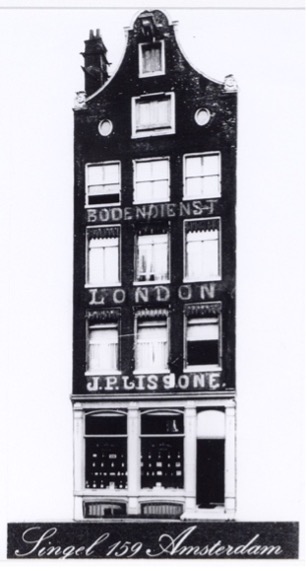
J.P. Lissone at Singel 159 in Amsterdam, circa 1890 (Archive: J.Ph.J.F. Lissone)
"The undersigned, fellow travellers from Amsterdam to London and back, hereby declare that the treatment on board the steamship “Maasstroom” and the pleasant stay in London exceeded all expectations. We are more than satisfied. With this venture, Mr J.P. Lissone has shown himself worthy of our public recommendation.”

Following this success, Jac organised more group trips to London. He accompanied all of them himself. The 1878 World's Fair in Paris prompted him to organise trips there as well. The Lissone travel agency began to take shape. It was the first of its kind in the Netherlands, with only the English Thomas Cook as a model in Europe.

“Patriarchal peace”, Nieuws van den Dag, 01-11-1894, Source: Delpher.nl

The number of trips and destinations steadily expanded, with trips to the Moselle, the Scottish Highlands, Switzerland, Italy, Norway and America, to name but a few. The popularity of travelling in a group increased. Jac himself had a hand in this. He advertised extensively and gave lectures across the country, enticing Dutch citizens who had previously rarely ventured far from home.


Lissone became a well-known name among the wealthy middle classes. Ladies who were unable to travel independently were among his most important target clientele. He did, however, set certain requirements for participants: they had to bring along a cheerful disposition and good manners. Unpleasant company could be removed from the excursion – with compensation, of course. He remained, above all, customer-focused.


In 1887, he began advertising under the name “Lissone's Tourist Bureau”. But it was not until 1891 that the company had grown large enough for the courier service and delicatessen business to be set aside. His wife, two sons and three daughters all joined in to help. To avoid unsettling his less emancipated clientele with the feminine involvement, the name was changed only to “Lissone & Son”. The division of responsibilities was clear: father and sons served as the affable and highly organised tour leaders, while his wife Catharina and daughter Cornelia looked after the company’s financial health with their business acumen. Daughters Johanna and Catharina took care of ticket sales and provided information to clients. The Lissone women also managed the business correspondence with all foreign hotels, shipping companies, railways, and so on. As the company grew, they were supported by more and more employees.


A talent for writing
In addition to all his “regular” work, Jacobus still found time for another pursuit: writing. In 1879, he published a novella entitled ‘Een nacht op de Noordzee’ (A Night on the North Sea). Unsurprisingly, this story takes place among a group of travellers aboard a steamship bound for England. Jacobus describes social relationships with gentle satire. His 19th-century sense of humour is evident in observations such as: “By my soul! I have seen dolls at Madame Tussauds in London whose features were more expressive than those of the British.” In 1896, under the pseudonym “Betsy van Amstel”, he published ‘Travelling with Betsy van Amstel’, followed in 1897 by ‘A Trip to the Isle of Wight (via London) with the Steamship Company ‘Zeeland’’. These publications were specifically aimed at female readers, to entice them to travel. He also wrote many travel stories in the magazine De Nederlandsche Tourist, which he founded himself.
Wester-Amstel
Business was going well for him, but it took a long time before he could call himself a grandfather. In 1898, his first and only grandchild was born: Ludvig Emil Movig, son of his daughter Cornelia and the Norwegian shipowner's son Severin Emil Movig. Jacobus adored the little boy. Grandparents, parents, grandson, and two unmarried daughters Johanna and Catharina all lived together in the now cramped house at Singel 163 in Amsterdam. It was time for something bigger. Something befitting the status of the now very wealthy family, and naturally set in a pleasant, leafy neighbourhood.

Announcement of the ‘Wester-Amstel’ auction in the ‘Frascati’ sales room (Source: archive of the J.Ph.J.F. Lissone Foundation)

It was the time when Amsterdam’s affluent bourgeoisie were moving to the Gooi and Kennemerland regions. The Lissones wanted something different. By now, the entire family was working in the travel agency. The women had to commute to the office every day, first on Singel, later on Leidsestraat and Dam Square. Their eyes fell on Wester-Amstel. It was practical, as it was easily accessible by carriage via the Amsteldijk, or by the new steamship service, which passed Wester-Amstel every fifteen minutes and would stop at the house’s jetty on request.


Jacobus, skilled in the art of auctions, made his move at a property auction in “Frascati” on the Nes in Amsterdam. After the purchase, he invested a similar amount in refurbishing the house and grounds. The clogged pond was emptied using an Archimedes screw and manually excavated again. A berry garden was laid out, a lane of hollyhocks was planted, and new fruit trees were added. A tea pavilion was also brought in by barge.


Wester-Amstel became a gathering place for friends and family of all denominations – quite literally. The talkative Catholic Jac quickly became good friends with the Protestant pastor of Ouderkerk. The pastor often stopped by Wester-Amstel after Sunday service. Officially, he was there to provide pastoral care to the Lutheran Catharina… The fact that he immediately joined Jacobus in the garden room with a good bottle of wine had to remain a secret in the strongly compartmentalised Netherlands.

Death
Jac Lissone died of a heart attack on 28 October 1907 at Wester-Amstel. He had been feeling unwell for several weeks and had remained at home, though he had been scheduled to travel to Berlin with a tour group. His final journey was by boat, across the Amstel to Zorgvlied. There he was laid to rest in the Catholic grave he had purchased in 1888 for his daughter Maria, who had died at the age of 22. He still rests there today.


The travel agency continued, first independently, under the leadership of his daughter Cornelia and son Jacques. After the First World War, it merged with Lissone-Lindeman. Eventually, it became part of TUI.


Wester-Amstel has remained in the hands of his descendants to this day.

De Nederlandsche Toerist, issue dated 28 October 1907 (archive of the J.Ph.J.F. Lissone Foundation)

By: Anja Lissone